


Capitalism is commonly understood to have emerged naturally from the decline of feudalism, alongside the expansion of global trade, the rise of private property, and the spread of liberal ideas. As Max Weber observed, capitalism “is not the product of a conscious human design but the result of a long historical process involving changes in culture, religion, and social organization.” Building on these foundations, the Industrial Revolution acted as a powerful catalyst, accelerating capitalism’s growth by expanding opportunities for capital accumulation, factory production, and global market reach, ultimately transforming it into its modern industrial form.
The Industrial Revolution is widely regarded as a direct outgrowth of the Enlightenment, the intellectual and cultural movement that shaped European thought from the late 17th to the early 19th century (circa 1680s to 1820s). The Enlightenment was characterized by an emphasis on reason, logic, and critical thinking, which gave rise to foundational concepts such as individual liberties and fundamental rights. It also involved a systematic challenge to traditional authorities— monarchy, church, and aristocracy—paving the way for secularism and the separation of religion from state affairs. Furthermore, it promoted scientific inquiry as a means to advance society.
The Industrial Revolution, in turn, fundamentally transformed the global economic structure and acted as a catalyst for the rise and institutionalization of capitalism as the dominant economic model. Understanding the extent to which the Industrial Revolution was shaped by Enlightenment ideals is essential, as this connection directly influences how capitalism was developed, justified, and implemented in the modern world.
However, while this narrative of Enlightenment-driven industrial progress is widely accepted, it deserves closer scrutiny. A critical examination reveals that the early stages of the Industrial Revolution were not the product of scientific advancement in the Enlightenment sense, but rather of empirical trial, mechanical ingenuity, and colonial exploitation. Moreover, the supposed alignment between Enlightenment values and industrial capitalism quickly unraveled, as the realities of exploitation, slavery, and imperial domination contradicted the very ideals of liberty, equality, and rational progress.
However, it is important to examine to what extent the traditional connection between Enlightenment and industrial modernity — from the perspective of technology and philosophy — is grounded in reality.
The origins of the Industrial Revolution are often portrayed as a triumph of science and the rational fruits of the Enlightenment. However, a closer and more impartial examination reveals that the true driving force behind this revolutionary era was not formal scientific discoveries. Rather, the revolution was primarily the result of inventions born out of the efforts of artisans, mechanics, and pragmatic experimentation. These innovations were not motivated by pure theoretical curiosity, but by immediate practical needs—such as increasing production, developing more efficient sources of energy, and processing large quantities of raw materials.
For example, the steam engine—often regarded as a symbol of industrial science—was actually an invention born out of practical challenges. Its earliest form, the atmospheric engine, was developed by Thomas Newcomen in 1712 in response to the problem of pumping water out of coal mines. It was not based on any scientific theory, but rather a direct engineering solution to an urgent need. Later, between 1765 and 1776, James Watt significantly improved the engine, but even these enhancements were grounded in empirical observations of heat, pressure, and motion— not in any established scientific framework. Surprisingly, the very science we now associate with the steam engine—thermodynamics—did not even exist at the time. This scientific discipline was developed in the 19th century by figures like Sadi Carnot and Rudolf Clausius, in order to better understand and improve the efficiency of engines after the fact.
By the same principle, many of the revolutionary inventions in the textile industry were also the result of artisan skill rather than scientific knowledge. James Hargreaves’ Spinning Jenny (1764), John Kay’s Flying Shuttle (1733), Richard Arkwright’s Water Frame (1769), and Edmund Cartwright’s Power Loom (1787) were all innovations that dramatically increased production speed and efficiency. However, these inventions were based purely on mechanical observations, local experimentation, and commercial pressures. They marked a shift from domestic modes of production to the factory system—but their driving force was not scientific theory or principle, rather the goal of improving performance and maximizing profit.
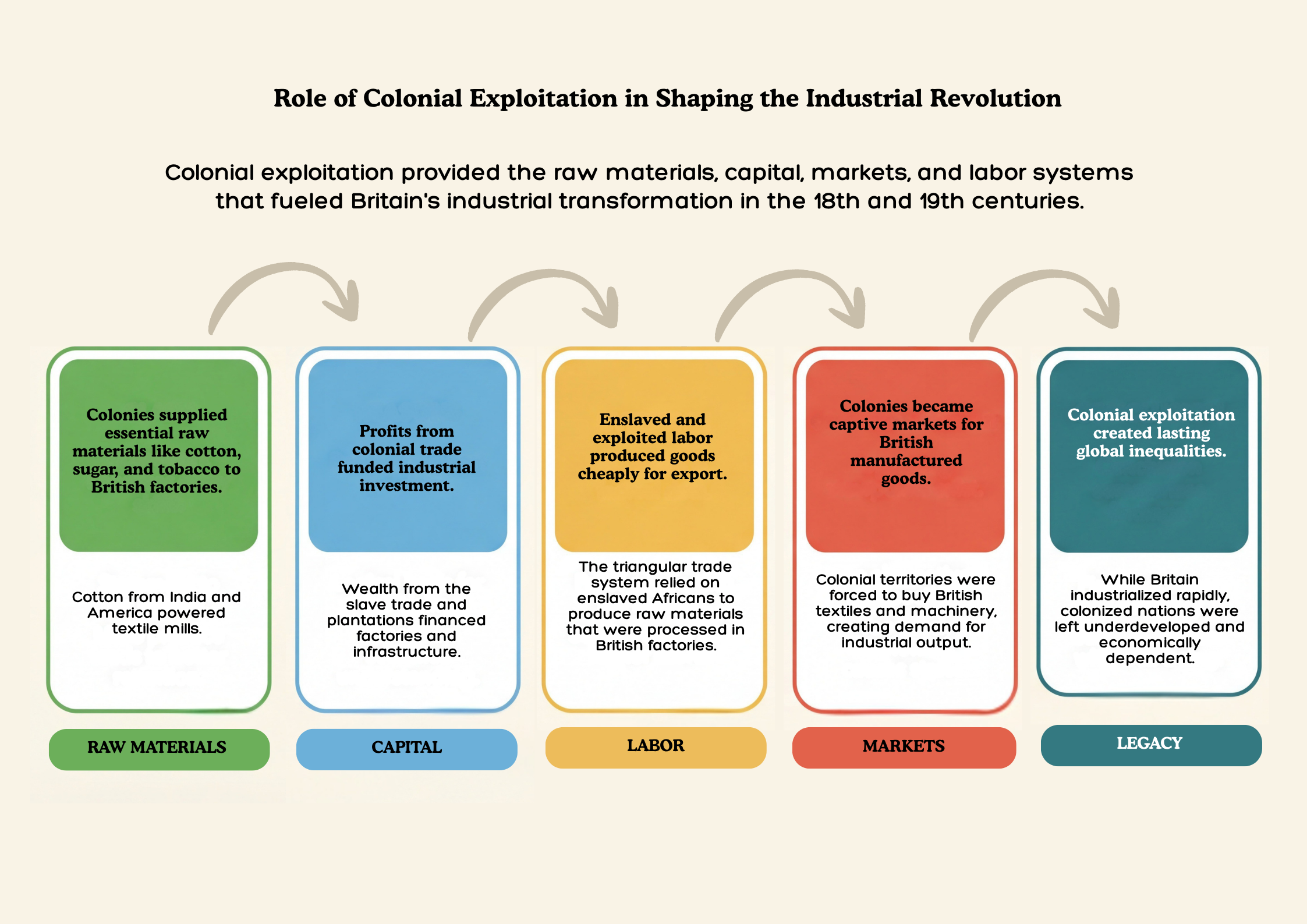
These inventions were also deeply rooted in the colonial economy. Their purpose was to process cotton grown through the labor of enslaved people in American and Caribbean colonies. Eli Whitney’s invention of the Cotton Gin (1793) made cotton cleaning significantly easier, which in turn increased the demand for slavery, as more cotton could now be processed at a faster rate. This raw material continuously fueled the textile mills of Britain. The colonies were not only supplying the raw materials for production but also serving as captive markets—forced consumer bases— where these industrial products were sold.
Around the same time, Abraham Darby’s 1709 invention—the use of coke to smelt iron—also revolutionized the industrial infrastructure. This technique produced cheaper and stronger iron, which became essential for building factories, railways, and machines. However, this advancement too was the result of practical, experimental skill rather than a scientific understanding of the chemical interactions between iron and carbon. At that time, the scientific foundations of metallurgy had not yet been established.
All these examples make it clear that technology was often ahead of science—that is, scientific theories emerged later to explain and refine these inventions, rather than giving rise to them in the first place. This fact further strengthens the argument that the Industrial Revolution was not merely a manifestation of Enlightenment-era scientific progress, but rather the outcome of a more complex, practical, and colonial evolution.
This integration of scientific knowledge with industrial innovation only began after 1850, during the second phase of industrialization, when scientific institutions, technical universities, and corporate R&D laboratories started to emerge. This historical reality challenges the widespread belief that reason and formal science directly gave birth to industrial modernity. As historian Joel
Mokyr notes in his book The Gifts of Athena (2002), although the intellectual legacy of the Enlightenment eventually began to influence industries, the initial wave of industrialization was largely non-scientific—driven instead by artisanal ingenuity, economic necessity, and imperial interests.
The true driving force behind these inventions was, in fact, colonial necessities — such as laying down vast railway networks to extract resources, which spurred innovations in engine technology; transporting cotton looted from the Indian subcontinent and the American South through slave labor to Europe; and developing textile machinery (as previously discussed) to rapidly process that cotton. Notably, many Enlightenment intellectual centers — like France and Germany — were academically advanced but lagged behind industrially, while Britain, though comparatively less engaged in philosophical activity, surged ahead in industrial development due to its abundance of coal, colonies, and capital.
Just as the scientific foundations of the Industrial Revolution were not as strong as the common narrative suggests, similarly the philosophical principles of the Enlightenment — on which the moral claims of modern Western civilization are built — faced severe contradictions in practical reality. Although the values of the Enlightenment era, such as human rights, individual freedom, and secularism, seemingly promoted the principles of liberty, equality, and reason, their practical implementation during the Industrial Revolution often contradicted these very principles. Thinkers like John Locke and Jean-Jacques Rousseau presented the idea of fundamental rights, including the rights to life, liberty, and property. Particularly, Locke’s view that every individual naturally has the right to freedom became the foundation of modern human rights discourse. However, these ideas stood in stark contrast to the ground realities of the time. During the Enlightenment and Industrial Revolution, slavery was not only maintained but was a central pillar of colonial economies. Millions of people, including African slaves, laborers from the Indian subcontinent, and colonial subjects, suffered from slavery, coercion, and economic exploitation during this so called age of “freedom.” This contradiction reveals that when the moral principles of the Enlightenment clash with practical realities, their true nature and limitations become apparent.
Similarly, individual liberty — which thinkers like Voltaire, Montesquieu, and John Locke regarded as a fundamental pillar of human dignity and liberation from tyrannical rule — was vigorously promoted during the Enlightenment era. Yet, during the same period, European powers such as Britain, France, Spain, and Portugal were expanding their colonial empires worldwide. The indigenous peoples of Africa, Asia, and the Americas were not only deprived of political sovereignty but their land, labor, and resources were systematically exploited under a colonial regime — all at the hands of the very European nations that loudly proclaimed the slogan of individual liberty.
Secularism, a key intellectual foundation of the Enlightenment, aimed to separate the state from the church and to place reason and logic at the center of political and social institutions. However, the reality is that during the same period, the colonial system repeatedly used religion as a tool of imperialism. Christian missionary activities were often presented as a moral justification for the expansion of European empires, where oppression, violence, and exploitation were disguised under beautiful slogans of salvation, civilization, and the will of God. The famous missionary
David Livingstone called Africa the “Land of Darkness” and declared: “I am going back to Africa to open the way for commerce and Christianity.” Such statements testify that rationalism and religious mission were not only merged but transformed into a colonial strategy — to dominate non-Christian peoples under the guise of Enlightenment ethics.
Another example of this contradiction can be seen in the philosophy of utilitarianism, which ostensibly advocated happiness and reforms but also became an ideological support for colonial rule. As industrial capitalism advanced, utilitarianism emerged as a moral philosophy aligned with the era’s emphasis on productivity, reforms, and social efficiency. Jeremy Bentham’s principle of “the greatest happiness of the greatest number” provided a secular ethical foundation compatible with industrial and liberal democratic progress, guiding reforms in public health, education, and governance. Although Bentham personally opposed slavery, his utilitarian logic was later used to justify imperial rule. British officials and intellectuals often claimed that the colonial system worked for the “collective good” by promoting development and improvement among “backward” nations. John Stuart Mill, a prominent utilitarian thinker and long-time employee of the British East India Company, wrote in his famous book On Liberty (1859):
“Despotism is a legitimate mode of government in dealing with barbarians, provided the end be their improvement.”
Such ideas provided an ideological cover for authoritarian rule in colonial regions like India, where British officials justified their governance as a temporary but necessary phase essential for the moral development of the subjugated peoples. The echoes of this paternalistic logic are also evident in Thomas Macaulay’s famous “Minute on Indian Education” (1835), where he claimed:
“A single shelf of a good European library was worth the whole native literature of India and Arabia.”
Here, Western knowledge and culture were naturally deemed superior, and the imposition of European values was portrayed as a “benevolent” act. In reality, these ideological frameworks concealed the material and cultural aggression of imperialism — such as resource plundering, political domination, and the erasure of local identities — while presenting imperialism as a philosophical and moral duty.
Thus, although the values of Enlightenment and Utilitarianism advocated for freedom, justice, and rational progress, these very principles were repeatedly used to justify colonial domination—under the guise of lofty slogans of human advancement.
Now that it is clear that the Industrial Revolution was neither primarily the result of scientific discoveries nor philosophical principles, it becomes essential to consider how European powers exploited colonialism to fuel this rapid industrial growth. Narratives like the “free market” and “natural progress” were, in fact, little more than myths. The true driving force behind the Industrial Revolution was a ruthless and systematic colonial exploitation.
Europe plundered raw materials like cotton, rubber, sugar, gold, and others from the colonies; deliberately destroyed local industries; and forced the colonized peoples to depend on imperial
products. This systematic plunder enriched the European elite, empowered factories, ports, and financial institutions, and continually deepened global inequality.
Thus, the stark reality emerges that the rise of industrial capitalism was built neither on the ethics of the Enlightenment nor on the invisible forces of free trade—but was founded on colonial crimes such as violence, oppression, and plunder.
This exploitation was particularly pronounced in the global cotton economy. By the 1830s, 70% of the cotton used in British textile mills came from South America, where it was cultivated by African slaves. By 1850, Britain was importing 588 million pounds of raw cotton, most of which was sourced from the slave plantations in America (Beckert, Empire of Cotton). British colonial policies deepened this exploitative system in India as well, where peasants were forcibly compelled to grow cash crops like indigo and cotton, which adversely affected staple food crops. Famines in Bengal worsened drastically from the 1770s due to this coercive system (Mukerjee, Churchill’s Secret War). In 1750, India accounted for about 24.5% of global industrial production, which declined to only 1.7% by 1900, while Britain’s share rose to 18.5% — all reflecting the exploitative role of the British colonial economy (Maddison, The World Economy). It is important to remember that it was this very looted cotton on which Britain’s textile industry was built — the same industry that was central to the beginning and expansion of the Industrial Revolution.
Similarly, the sugar plantations of the Caribbean became a major source of colonial wealth that fueled industrial development. By the eighteenth century, islands like Jamaica, Barbados, and Saint-Domingue (present-day Haiti) were producing large quantities of sugar for European markets. By 1790, Saint-Domingue alone supplied nearly 40% of Europe’s sugar and accounted for about two-thirds of France’s overseas trade, making it France’s most valuable colony (Eric Williams, Capitalism and Slavery). The immense profits generated from this trade were invested in British banking and financial institutions—such as Barclays, Baring Brothers & Co., and Lloyds Bank—which channeled the capital into industry, transportation, and infrastructure, providing the financial foundation for the Industrial Revolution. The production of sugar and the demand for its market not only structured the colonial economy but also fundamentally transformed public consumption in Europe, the diet of the working class, and production systems. As the anthropologist Sidney Mintz wrote in his famous book Sweetness and Power:
“The story of sugar is one of those few threads that tie together the history of industry, imperialism, slavery, and mass consumption.”
This excerpt clearly demonstrates that sugar was not merely an agricultural commodity but a key structural element of colonial capitalism, without which neither industrial production would have expanded nor would Europe’s economy have gained the energy that propelled it toward global dominance.
After cotton and sugar, rubber emerged as an indispensable commodity during the second phase of the Industrial Revolution (from the late nineteenth century to the early twentieth century). The growing demand for rubber made possible the production of machinery belts, telegraph insulation, bicycle and automobile tires, and waterproof goods. This rising demand gave birth to one of the most brutal colonial systems in history: the Congo Free State, which was directly ruled by King
Leopold II of Belgium. During Leopold’s reign, the Congolese people were forcibly compelled to collect wild rubber, families were taken hostage, and those who failed to meet quotas had their body parts severed. According to Adam Hochschild’s book King Leopold’s Ghost, this brutal regime resulted in the deaths of nearly ten million Congolese due to forced labor, starvation, disease, and terror.
In 1890, rubber exports from the Congo were approximately 580 tons, which increased to over 3,500 tons by 1904. Leopold earned a profit of 220 million francs (equivalent to about 1.1 billion US dollars today) from this brutal trade, which was spent on building royal palaces and museums in Belgium.
European concessionary companies such as the Anglo-Belgian India Rubber Company (ABIR) also earned profits of nearly 700% from this brutal system, while the price of rubber increased tenfold between 1890 and 1905. Industrial giants like Michelin, Dunlop, and Continental heavily relied on Congo’s rubber for the growth of their industries, clearly showing that Europe’s industrial development was not only based on colonial exploitation but was directly supported by these brutal systems. Thus, the rubber trade not only enriched Leopold II’s regime and European capitalists but also provided a fundamental fuel for the entire industrial capitalist system.

Alongside rubber, cotton, and sugar, precious metals like gold and silver also played a fundamental role as fuel for industrial capitalism within the colonial economy. Since the 16th century, Spanish and Portuguese colonies extracted enormous quantities of silver and gold from mines in regions such as Potosí (Peru) and Zacatecas (Mexico). The mines of Potosí alone supplied over 60% of the world’s silver during the 17th century. According to Eduardo Galeano, between 1500 and 1800, more than 45,000 tons of silver were transferred to Europe. These metals supported European empires’ wars, expansion, and financial systems, laying the foundation for international trading banks such as Baring Brothers and Rothschild & Co., which later became crucial for global trade, sovereign debts, and ultimately the financial backbone of industrial capitalism.
The famous British “Guinea” coin, named after the gold obtained from Africa’s “Gold Coast” (now Ghana), symbolizes how deeply colonial resources were integrated into the European financial system. The discovery of gold in 1886 at Witwatersrand in South Africa made the region the world’s largest gold producer. The deposits around Johannesburg gave rise to large-scale mining operations, which dominated the global gold market until the early 20th century. Companies such as De Beers Consolidated Mines and Consolidated Gold Fields monopolized gold mining and exports. The wealth extracted from these mines vastly expanded the British financial empire, and London banks began spreading gold-based investments worldwide.
This very colonial wealth—particularly the capital derived from precious metals—later became the foundation of modern capitalism, where financial markets, international debts, and global investment structures grew out of these initial imperial reserves. Systems like the Gold Standard were essentially built upon colonial-era wealth, stabilizing the capitalist economy at the international level. Thus, colonial metals were not merely fuel for industries but laid the financial foundations of the modern global capitalist system—a system that to this day has not fully freed itself from its colonial legacy.
Europe’s industrial development was not based solely on acquiring raw materials, but was also fundamentally reliant on forced labor and slavery, which were indispensable for supplying these resources and meeting industrial demands. According to Eric Williams, British merchants earned immense profits from the “Triangular Trade,” which were reinvested into banking, shipping, infrastructure, and early industrial ventures. This trade system spanned from the 16th to the 19th century across Europe, Africa, and America, forming the backbone of the Atlantic slave economy. European ships carried manufactured goods such as cloth, guns, alcohol, and metals from Europe to Africa, where these were exchanged for African slaves. These slaves were transported via the “Middle Passage” to the Americas, where they were sold under brutal conditions. From there, slave-produced goods like sugar, tobacco, cotton, and rum were shipped back to Europe.
Approximately 12 million Africans were forcibly transported to America, with Britain controlling the largest share during the 18th century (Thomas, The Slave Trade). Between 1700 and 1807, British ships transported about 3.5 million slaves from Africa to America, and 40 percent of the European slave trade was carried out through the port of Liverpool alone. Although Britain declared the slave trade illegal in 1807, industrial capitalism continued to rely on cotton produced by American slavery, even up to the American Civil War (1861–65).
By 1800, the Atlantic slave trade had brought an estimated benefit of £60 million to the British economy, which translates to hundreds of billions of pounds in today’s terms (Inikori, Africans and the Industrial Revolution in England; Blackburn, The Overthrow of Colonial Slavery). The rise of the port of Liverpool was also largely based on the slave trade and colonial exports.
These profits fueled not only British ports but also the entire industrial and financial infrastructure. Cities like London, Bristol, and Glasgow became centers for banking institutions, insurance companies, and manufacturing factories built on wealth derived from the slave economy. Insurance firms such as Lloyd’s of London provided coverage for slave ships, while banks like Barclays and Baring Brothers became financial hubs for traders and investors involved in the slave trade. Thus, many pillars of industrial capitalism were directly supported by wealth obtained from slave markets, continuously strengthening the structure of modern capitalism.
Thus, the rise of the Industrial Revolution and capitalism was not merely the spontaneous result of scientific discoveries, technology, or rational progress, as is often portrayed in mainstream narratives. Rather, its foundation was deeply rooted in colonial exploitation, slavery, forced labor, and systematic plunder of resources. European powers obtained human capital from Africa, raw
materials from Asia, and precious metals from Latin America through extremely brutal means. The wealth derived from these was used to build industrial infrastructure, banking, trade, and state power. The slave trade, forced cultivation of cash crops, and colonial despotism provided Europe with the economic bases on which the edifice of modern capitalism was constructed. As a result, Europe not only maintained its industrial dominance but also economically subordinated and underdeveloped the rest of the world, the effects of which are still evident in the global economic system today.
Whereas it is falsely claimed that the Industrial Revolution was merely the logical outcome of scientific research and Enlightenment ideas, the concept of a “natural” and “free” global market within the framework of capitalism is also an ideological deception that does not align with
historical evidence. In reality, colonial powers did not acquire the resources and markets needed for industrial capitalism by chance, but through deliberate and systematic coercion. The attractive veil of the “free market” was actually part of a political and military strategy to maintain this exploitative structure. A clear example of this is the Opium Wars (1839–1842, 1856–1860) between Britain and China. When Britain faced deep reluctance in the Chinese market for its goods compared to the growing demand for Chinese tea, it began illegally exporting opium to China to correct the trade imbalance. When the Chinese government took action against this devastating addiction, Britain imposed war and forced unequal treaties like the Treaty of Nanking in 1842, under which China ceded Hong Kong to Britain, opened ports, paid heavy reparations, and legalized opium imports. These measures not only crippled China’s economy and weakened its sovereignty but also provided Western powers with a new lucrative market. Thus, the global expansion of the capitalist system, often called “free trade,” was in reality colonial domination enforced through military power, economic coercion, and political pressure.
Similarly, the colonial-era infrastructure appeared to be a sign of development, but its true nature was based on imperial exploitation rather than the welfare of the local population or industrial self sufficiency. By 1900, over 56,000 kilometers of railway lines had been laid in British India — making it one of the largest railway networks in the world — but their primary purpose was to transport raw materials such as cotton, coal, and jute from the interior to port cities like Mumbai, Kolkata, and Karachi, from where they could be exported to European markets. Even during times of famine, the railway transportation of food was minimal; only 8 percent of freight consisted of food items, which proves that the railways’ main objective was not local needs but export interests. According to researcher Daniel Thorner, this railway network was built not to develop Indian industry but to serve British commercial interests (Thorner, The Pattern of Indian Agriculture, 1950).
Another prominent example of this strategy was the opening of the Suez Canal in 1869, which reduced the sea distance from London to Bombay by nearly 5,000 nautical miles and cut travel time by about 40 percent. Within just two decades, Anglo-Indian trade tripled through this canal, enabling the rapid transport of Indian cotton, Egyptian grain, and Southeast Asian rubber to European factories. By the 1880s, Britain controlled about 80 percent of the canal’s total traffic, clearly demonstrating that colonial infrastructure not only connected local economies to European economic interests but also served as a practical tool to maintain imperial domination (Davis, Late Victorian Holocausts, 2001).
Ultimately, the Industrial Revolution was neither merely the result of scientific discoveries nor a natural extension of the intellectual principles of the Enlightenment. The reality is that the development of industrial capitalism was primarily made possible through exploitation, forced labor, and colonial plunder. The vast wealth of this era, which provided the extensive capital necessary for industrial growth, was not the outcome of philosophical or moral ideas but was acquired through systemic oppression, coerced labor, and the organized looting of natural resources across the world. This wealth was not a coincidence or a natural flow; rather, it was a complex colonial system deliberately designed to serve imperial and capitalist interests. Another manifestation of this system is seen in colonial infrastructure projects such as the railway network in British India and the construction of the Suez Canal. On the surface, these infrastructures appeared as symbols of progress, but their primary purpose was neither the welfare of the local
population nor industrial self-sufficiency. Instead, they aimed to accelerate the transport of raw materials and safeguard the commercial interests of colonial powers. Ninety-two percent of freight traffic on India’s railway network was dedicated to raw materials and exports, while food transport was minimal—highlighting the system’s skewed priorities. Similarly, the Suez Canal enabled faster movement of goods from Europe to India but ensnared local economies within exploitative circuits and brought extraordinary financial gains to European capitalist powers. Furthermore, the notion of a “natural” or “free” global market was promoted to stabilize industrial capitalism, yet this idea was essentially an illusion. In reality, colonial powers deliberately used economic coercion and forced treaties to establish dominance over specific markets and secure resources for industrial growth. This is evident in Britain’s Opium Wars against China, where military force was used to impose trade restrictions and forcibly open Chinese markets to British goods, undermining China’s sovereignty and expanding the profitable markets of global capitalism. All these facts challenge the traditional historical narrative that portrays the Industrial Revolution solely as a product of scientific progress and Enlightenment ideals. In truth, the economic and political foundations of modern industrial capitalism were built upon colonial oppression, forced labor, and systematic exploitation—shaped more by global power strategies and commercial interests than by inventions or intellectual theories.
An important aspect that demands attention is that capitalism is fundamentally based on the doctrine of the separation of religion and worldly affairs—i.e., secularism. According to this ideology, human life is organized solely on the basis of human reason and interest, without any divine guidance. However, the truth is that Allah Almighty is the Creator of humans, life, and the universe, and He created humans with a purpose—to follow His commands in their individual, collective, political, economic, and cultural lives. From the perspective of the secular capitalist system, material profit is the central focus of all human activities. This very mindset naturally leads capitalism toward colonial exploitation because when profit is considered the absolute good, the exploitation of other people and nations becomes justifiable—provided it is “beneficial” according to the measure of interest. As mentioned earlier, capitalism has tried to morally justify the colonial system by employing concepts such as utilitarianism—that if an action results in overall benefit (for example, the progress of Europe), then means such as oppression and exploitation are acceptable. Furthermore, capitalism has failed to regulate human instincts—such as survival instinct—within a moral and divine framework. Consequently, this system only progresses when it unleashes these instincts without restraint, and this lack of control forces it to continuously rely on methods like colonialism, monopolies, and economic slavery. History bears witness that Western powers, in order to ensure their survival and meet economic needs, not only ruthlessly exploited other nations but also transformed their resources, labor, and autonomy into their own industrial and military power. Therefore, capitalism’s secular, profit-driven, and ethics-deficient ideology necessarily produces exploitation. Unless this ideological foundation is challenged, it is impossible to separate capitalism from oppression and colonialism.
We must remain vigilant and not be deceived by the alluring slogans of “freedom,” “human rights,” “secularism,” the “Enlightenment era,” and the “Industrial Revolution.” These concepts may appear to represent human progress, but in reality, they are narratives crafted by colonial powers with the aim of global domination, resource plunder, and binding nations of the world into intellectual slavery. These narratives were fabricated to morally justify colonial atrocities. Therefore, it is essential to expose these deceptive claims. The colonial system and its ideology
are fundamentally at odds with Islam, because Islam neither permits exploitation of others nor accepts a system based on selfish material interests. Islam is the only system revealed by Allah. It is in harmony with human nature, founded on justice, and guarantees both spiritual and material well-being. Only Islam provides true salvation for humanity.

No Related Post
This will close in 20 seconds

