We are living in an era dominated by secularism. Many Muslims, impressed by the West, have adopted it under the assumption that it is an Islamic ideology, whereas it is a different and anti-Islamic ideology. To uncover the truth, we must look at its history to understand how this ideology emerged.
With the fall of the Roman Empire (after the 3rd century AD), the Church gained a significant role in power, and after Constantine, a union between the Church and the State was established. This alliance gave rise to long-standing political and social problems in Europe. By adopting the Roman system, the Church gained complete control over legislation, education, and governance, while kings also remained under their influence. The Pope held supreme authority, appointing cardinals, bishops, and other priests, and maintained total control over judicial and financial matters. The Church exploited the masses in the name of religion, gaining wealth in exchange for promises of heaven, and severely punished opponents, especially scientists. Women were also subjected to oppression and violence. Due to fear, the public was unable to speak out, a period known in European history as the “Dark Ages.” By the 14th century, rebellions against these atrocities began. The reasons included defeat in the Crusades and the Church’s failure to solve social problems, which eventually led to the restriction of the Church’s power.
At the same time, the atrocities of the Church forced the thinkers and philosophers of that era to seek a way to get rid of the state that was oppressing people in the name of religion. These philosophers first began to reflect on the reality of human beings and the meaning of life. They declared the human being the foundation of reality. This included the idea that human reason is the tool that leads a person to objective reality. They further stated that if progress is to be made again today, we must base our lives on human reason. In fact, the cruelties of the Church forced
these philosophers to lay the foundation of a system of life based on intellect.
According to them, a human being is inherently free, and this freedom demands four basic freedoms that no one can take away. They said that a person has freedom of religion, meaning they can choose or leave any religion they like whenever they want, and no one can interfere. Then they said a person has freedom of ownership, meaning they can keep anything as their property. Additionally, a person has freedom of expression, meaning human existence demands that one expresses their opinion without any fear. Furthermore, they have personal freedom, meaning they can perform any action they like.
According to these philosophers, man is inherently good; it is religion that oppresses him and forces him toward evil. Therefore, if human goodness is to be utilized, he must be freed from the chains of religion. For this reason, they presented the idea that “the state should have no connection with religion.” This thought is essentially the core of all their efforts and the foundation upon which Western leadership is built today. This is a highly poisonous thought.
Over time, as this thought flourished and the West accepted it, they tried to spread this ideology throughout the Islamic world through various means. This was an era when Muslims were suffering from intellectual decline and were no longer capable of looking at things through an “Islamic lens.” Instead of testing this thought against Islamic principles and judging it through Islam, they could not counter this toxic ideology and were influenced by it. The progress of the West forced them to believe that even today, the only means of progress lies in adopting secularism at the state level.
Because of this, they adopted secularism in both its parts and its whole, and after adopting it, they began using Islam as an argument for their opinion. Regarding the four basic rights, they claimed that these freedoms are exactly what Islam gives to people. On this basis, the famous poet Ahmad Shawqi uttered the blasphemoussentence that “Muhammad (PBUH) was the greatest secularist.”
To examine the weakness of their thinking, it is necessary to review their principlesand arguments in detail one by one, so that their intellectual misunderstanding can be seen in a reasoned manner. To weigh the concept of freedom of religion in Islam in the scales of modern
Western secularism is a serious academic and intellectual fallacy, based on presenting Quranic verses out of context. The secular class generally uses the verse of Surah Al-BaqarahTo examine the weakness of their thinking, it is necessary to review their principles and arguments in detail one by one, so that their intellectual misunderstanding can be seen in a reasoned manner. To weigh the concept of freedom of religion in Islam in the scales of modern Western secularism is a serious academic and intellectual fallacy, based on presenting Quranic verses out of context. The secular class generally uses the verse of Surah Al-Baqarah لَاۤ اِكْرَاهَ فِی الدِّیْنِ (There is no compulsion in religion) and the verse of Surah Al-Kahf فَمَنْ شَآءَ فَلْیُؤْمِنْ وَّ مَنْ شَآءَ فَلْیَكْفُرْۙ (So whoever wills, let him believe; and whoever wills, let him disbelieve) as a shield to give the impression that Islam is a “secular” or personal choice religion, whereas the real purpose and background of these verses are completely different.
If we look at these verses in their complete text and context, the reality of the secular narrative becomes clear. For example, in the verse of Surah Al-Kahf, when Allah Almighty says that whoever wills may believe and whoever wills may disbelieve, this is not permission for an “absolute choice” but a very severe warning and the finality of proof. The proof of this is the very next sentence which secularists often hide: اِنَّاۤ اَعْتَدْنَا لِلظّٰلِمِیْنَ نَارًاۙ-اَحَاطَ بِهِمْ سُرَادِقُهَاؕ (Indeed, We have prepared for the wrongdoers a fire whose walls will surround them). Here, the tone of giving choice is the same as when an elder angrily says to a disobedient person, “Do whatever you feel like, then see the consequences.” This means the choice of disbelief is not a “human right” in the sight of Allah, but a serious crime whose punishment is Hell. Similarly, the verse of Surah Al-Baqarah لَاۤ اِكْرَاهَ فِی الدِّیْنِ is about not forcing non Muslims to accept Islam (because the truth has become clear), not for giving Muslims permission to leave the religion.
Entering the religion of Islam does not merely mean adopting an ideology; rather, it is entering into a “Contract” (covenant) with Allah, the fulfillment of which is obligatory upon both the individual and the state. When a person enters the fold of Islam of their own free will, they accept the complete authority of Islamic law. In Islam, apostasy (leaving the religion) is not just a personal decision; rather, it falls under the category of rebellion and treason against the ideological foundation of the Islamic state. This is why the Holy Quran says regarding those who oppose Allah and His Messenger: ذٰلِکَ بِاَنَّہُمۡ شَآقُّوا اللّٰہَ وَ رَسُوۡلَہٗ ۚ وَ مَنۡ یُّشَاقِقِ اللّٰہَ وَ رَسُوۡلَہٗ فَاِنَّ اللّٰہَ شَدِیۡدُ الۡعِقَابِ (And that is because they opposed Allah and His Messenger. And whoever opposes Allah and His Messenger—then indeed, Allah is severe in penalty). Here, the word “shaqqu” carries the meaning of breaking away from a system, which is the worst form of treason.
The negation of Western-style “absolute freedom of religion” in Islam is also definitively proven by the Prophetic Hadith, as the Holy Prophet (PBUH) said: مَنْ بَدَّلَ دِينَهُ فَاقْتُلُوهُ (whoever changes his religion, kill him). This command is final proof that in Islam, the path to come “from the outside in” is one of invitation and choice, but the path to go “from the inside out” is legally blocked. No sovereign system in the world allows its rebels to shake the foundations of the state. Therefore, this “dishonesty” of secular intellectuals—claiming that Islam allows every kind of religious change—is entirely false. Islam grants non-Muslims the freedom to remain upon their religion (as Dhimmis), but it leaves no room for Muslims to deviate from the faith. It is proven that reading these verses in their original context makes it clear that the concept of “freedom of religion” presented by secularism does not exist in Islam at all; rather, it is a matter of the sanctity of the religion and the stability of the ideological state.
Next, they claimed that Islam also gives man Western-style “Absolute Freedom of Ownership.” They argue that since Islam allows a person to own a house, gold, animals, and vast wealth, the Islamic economic concept is exactly in line with their capitalist and unrestrained concept of “private property.” This thinking is actually the result of their misunderstanding and a superficial study of the Islamic economic system. The secular class deliberately tries to create the impression that a person can own whatever they want, however much they want, and in whatever way they want, whereas in reality, Islam does not believe in unlimited private ownership but divides ownership into three basic categories.
Therefore, if the Islamic economic system is examined deeply, it becomes clear that Islam does not stand on the single pillar of “Private Property.” Instead, based on the fair distribution of wealth and human welfare, this system divides ownership into three distinct types: Private, Public, and State ownership. Under private ownership, a person is the owner of their lawfully earned wealth and resources. However, from a human and Shariah perspective, Islam declares certain basic necessities as “Public Property” and does not allow any individual or corporation to establish a monopoly over them. As the Prophetic Hadith states: الْمُسْلِمُونَ شُرَكَاءُ فِي ثَلَاثٍ: فِي الْمَاءِ وَالْكَلَإِ وَالنَّارِ (Muslims are partners in three things: water, pastures, and fire/energy). The purpose of this is to prevent those resources on which human survival depends and which are items of common use from being imprisoned in the vaults of a few capitalists, keeping them open for all of humanity.
As mentioned in another narration: “Hazrat Abyad bin Hammal (RA) came to the service of the Messenger of Allah (PBUH) and asked for a large salt mine (located in the area of Ma’rib) as an estate. Initially, the Prophet (PBUH) granted that mine to him. But as he turned to leave, a companion present in the gathering submitted: ‘O Messenger of Allah! Do you know what you have granted him? You have given him “al-Ma’ al-‘Id” (continuous water or a never-ending treasure).’ Upon realizing that this mine was not ordinary private land but a vast natural resource on which the needs of the entire society depend, the Messenger of Allah (PBUH) revoked his decision and took the salt mine back from him.”
This incident cuts the roots of the secular and capitalist narrative that portrays Islam as a supporter of unlimited private ownership. In the capitalist system, public property like minerals, oil, gas, or salt mines is tossed into the laps of a few corporations or individuals to economically exploit the entire nation, which they call “freedom of ownership.” Similarly, the third type is “State Property,” in which the state keeps certain major resources under its management for the collective welfare of society and to run the system of government. This proves that an individual cannot “own” everything.
Along with these categories, Islam does not merely define the circles of ownership; it also places strict restrictions on the means of its acquisition and expenditure, which cuts the roots of secular economic freedom. In a capitalist system, a person can build wealth through their own will and desire by engaging in gambling, alcohol, narcotics, or interest-based businesses, but in Islam, doing so is strictly forbidden. The clear command of the Holy Quran is: وَ اَحَلَّ اللّٰهُ الْبَیْعَ وَ حَرَّمَ الرِّبٰواؕ (Allah has permitted trade and forbidden interest). These Shariah restrictions are irrefutable proof that human ownership is not unlimited or subject to one’s desires. A Muslim can neither become the owner of everything nor can they earn through every method. Therefore, the attempt to mold Islam into a secular frame in the name of freedom of ownership is not only contrary to the facts but is also a negation of that beautiful balance in the Islamic system which prevents wealth from concentrating in a few hands.
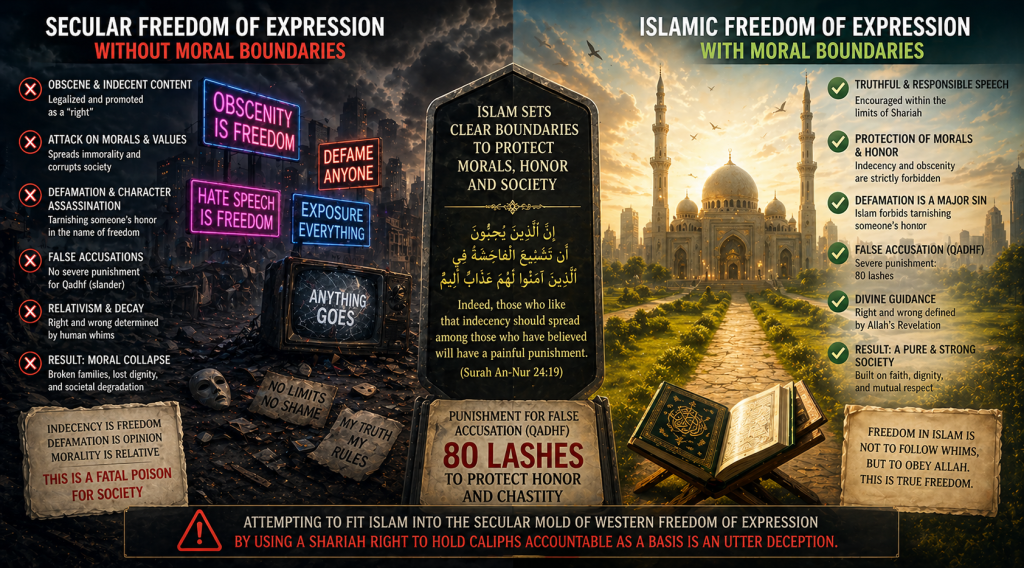
Following this, viewing the Islamic concept of “Freedom of Speech” through the lens of Western secularism and declaring them equal was another major intellectual fallacy they fell victim to. To give weight to their narrative, the secular and liberal class often presents examples of the accountability of the Rightly Guided Caliphs from Islamic history. Specifically, they refer to the famous incident of Hazrat Umar Farooq (RA) when he stood on the pulpit to deliver a sermon and said, “Listen and obey.” An ordinary man stood up from the gathering and said, “We will neither listen nor obey until you tell us how you made this long tunic from the spoils of war when everyone received only one sheet of cloth, especially since you are a tall man?” Instead of getting angry, Hazrat Umar (RA) asked his son, Hazrat Abdullah bin Umar (RA), to stand up, who explained that he had given his portion of the cloth to his father so that his tunic could be completed. Secular intellectuals present this incident and “cut corners” by claiming that look, Islam gives freedom of expression against the state or every kind of unrestrained freedom, and a human has total
liberty to say anything.
The reality is that this claim, like their other arguments, is completely incomplete and cut off from its context. If this incident is analyzed deeply, the question asked by that Companion was not “freedom of expression” in the Western sense; rather, it was a Shariah-based accountability regarding the implementation of the law and the provision of justice by the ruler (i.e., the equal distribution of spoils). In Islam, you have complete freedom to speak the truth, raise a voice against oppression, and hold rulers accountable within the limits of Shariah, but this freedom of opinion
is bound by the limits defined by Shariah. Islam, unlike Western secularism, absolutely does not allow you to insult sacred personalities, attack the foundations of the faith, or mock the commands of Allah and His Messenger (PBUH) under the guise of freedom of expression. Disrespect or criticism regarding the honor of the Holy Prophet (PBUH) is not freedom of opinion in Islam but the worst of crimes, upon which the clear and final verdict of Shariah exists in the form of the Prophetic Hadith: “مَنْ سَبَّ نَبِيًّا فَاقْتُلُوهُ” (Whoever insults a Prophet, kill him). No secular society can digest this Shariah law because their freedom of expression provides legal protection to blasphemy and the desecration of the sacred.
Furthermore, in Islam, there is absolutely no room to destroy the morals of society, spread indecency and obscenity, or tarnish someone’s honor in the name of freedom of expression. In Western societies, obscene material and moral degradation are considered legal rights in the name of freedom, but Islam declares this a fatal poison for society. The clear and categorical command of the Holy Quran is: “اِنَّ الَّذِیْنَ یُحِبُّوْنَ اَنْ تَشِیْعَ الْفَاحِشَةُ فِی الَّذِیْنَ اٰمَنُوْا لَهُمْ عَذَابٌ اَلِیْمٌ” (Indeed, those who like that indecency should spread among those who have believed will have a painful punishment). Similarly, Islam has prescribed a severe punishment (80 lashes) for leveling a false accusation (Qadhf) against a chaste person so that people’s honor remains protected. Does any secular society accept these restrictions and moral boundaries placed by Allah on freedom of expression? Not at all. Therefore, attempting to fit the entire Islamic system into the secular mold of Western freedom of expression by using a Shariah right to hold Caliphs accountable as a basis is an utter deception.
At the end of all these discussions comes the biggest and most deceptive claim of the so-called “Islamic Secularists”: “Personal Freedom.” They do not merely rely on Western slogans but also seek support from Quranic verses and Islamic principles to provide a justification for this unrestrained way of thinking. Their biggest argument is that religion is entirely a “private matter between God and the servant.” To prove this stance, they present the Quranic verse “وَلَا تَزِرُ وَازِرَةٌ وِزْرَ اُخْرٰی” (No bearer of burdens shall bear the burden of another) as evidence. Using this verse, they argue that since every individual must account for their own deeds to Allah on the Day of Judgment and no one else is responsible for them, what right does the state, law, or society have to interfere in someone’s personal life, dress, food and drink, or marriage affairs?
Furthermore, this group deliberately mixes the Western liberalism’s “Harm Principle” with the Islamic concept of “Haquq-ul-Ibad” (rights of fellow humans). They claim that if a person is not directly harming someone else through a personal act, no restriction can be placed on their personal freedom. To strengthen this narrative, they raise the slogan “My Body, My Choice.” However, they intentionally ignore the clear and collective command of the Quran where society is obligated to perform Amr bil-Ma’roof (Enjoining Good) and Nahi ‘anil-Munkar (Forbidding Evil) instead of being silent spectators to waywardness. Allah Almighty says: “كُنْتُمْ خَیْرَ اُمَّةٍ اُخْرِجَتْ لِلنَّاسِ تَاْمُرُوْنَ بِالْمَعْرُوْفِ وَ تَنْهَوْنَ عَنِ الْمُنْكَرِ” (You are the best nation produced for mankind. You enjoin what is right and forbid what is wrong). This verse proves that in Islam, sin is not merely a “private matter”; rather, stopping society from evil is the collective responsibility of the entire Ummah.
This secular thinking is the result of not understanding the reality of a human being through the pure lens of Islam. According to Islam, a human is not a sovereign being but an “Abd” (meaning a slave and servant) of Allah. Islam has not left human actions at the mercy of desires but has confined them within the strict circle of the five basic rulings of Shariah (Fard, Haram, Mandub, Makruh, and Mubah). The Quran cuts the very root of this concept of “absolute personal freedom” when it announces that a human’s own will has no status in the face of the commands of Allah and His Messenger (PBUH). In Surah Al-Ahzab, it is categorically stated: “وَ مَا كَانَ لِمُؤْمِنٍ وَّ لَا مُؤْمِنَةٍ اِذَا قَضَى اللّٰلهُ وَ رَسُوْلُهٗۤ اَمْرًا اَنْ یَّكُوْنَ لَهُمُ الْخِیَرَةُ مِنْ اَمْرِهِمْ” (It is not for a believing man or a believing woman, when Allah and His Messenger have decided a matter, that they should [thereafter] have any choice about their affair).
Now reflect with reason: when a Muslim cannot abandon an obligation (Fard) under any circumstances and cannot go near what is forbidden (Haram) even behind closed doors (even if it apparently does not harm anyone else), then where does that Western-style “absolute freedom” remain that this group claims?
Moreover, the Western theory of bodily autonomy in the name of personal freedom is also completely void in Islam. The West says, “This is my body, I can do whatever I want with it,” whereas the final decision of Islam is that a human’s body is not their personal Property. Tomorrow, on the Day of Judgment, instead of being subject to human’s will, this body will testify against them in the court of Allah. The Quran says: “یَوْمَ تَشْهَدُ عَلَیْهِمْ اَلْسِنَتُهُمْ وَ اَیْدِیْهِمْ وَ اَرْجُلُهُمْ بِمَا كَانُوْا یَعْمَلُوْنَ” (On a Day when their tongues, their hands and their feet will bear witness against them as to what they used to do). This is why in Islam; a human does not have absolute authority even over their own body; they are not even authorized to intentionally harm themselves or take their own life. Allah Almighty says: “وَ لَا تَقْتُلُوْۤا اَنْفُسَكُمْؕ-اِنَّ اللّٰهَ كَانَ بِكُمْ رَحِیْمًا” (And do not kill yourselves. Indeed, Allah is to you ever Merciful). When a human does not have the freedom to take their own life, harm their own limbs, or establish forbidden relationships of their own will, the Western concept of absolute personal freedom and “My Body, My Choice” reaches its end and dies right there. Therefore, it is proven that the meaning of freedom in Islam is not the blind following of the self (Nafs), but the name of living life within the limits set by Shariah while wearing the collar of servitude to Allah.
Another major intellectual fallacy and deception of secular and Western liberal philosophy (especially the thinking of thinkers like Rousseau) concerns the fundamental reality of a human being. Their crude claim is that man is naturally—meaning by birth and by nature—completely good and innocent, and it is the state, society, or especially “religion” those places restrictions on him and makes him prejudiced, extremist, or evil. This theory was crafted to prove that religion is an obstacle in the path of human freedom and evolution. However, if we reflect on the reality of man in the light of truth, this secular hypothesis proves to be entirely contrary to ground realities and is merely a wall of sand.
A look at reality reveals that a human being is neither purely “good” like angels nor purely “evil” like devils. Man is a collection of “Instincts” and “Organic Needs.” Indispensable organic needs like hunger, thirst, and sleep, along with instincts such as the instinct for survival, the procreation instinct, and the religious instinct, are naturally endowed within man and cannot be eliminated. These instincts and needs are, in themselves, completely neutral; that is, they are neither good nor bad. Instead, the determination of good and evil in human actions does not come from the existence of these instincts, but from the “method” chosen to satisfy them.
When a person satisfies these uncontrollable natural urges under a system in the light of Divine revelation and the rules set by the Ruler of all Rulers—for example, satisfying the survival instinct through lawful trade and the procreation instinct through the pure bond of marriage—then this very act takes the form of “Good” and becomes worthy of praise and reward in the court of Allah. In contrast, when a person turns away from Divine commands and leaves these instincts unrestrained in the blind storm of carnal desires—for example, adopting the path of interest and exploitation for wealth, or adultery and indecency for sex—then this very act falls into the category of “Evil” and becomes condemnable in this world and the hereafter.
Therefore, no human is good or bad by birth; rather, it is their conscious “choice” and their “actions” that make them good or bad. Thus, it is proven that religion does not make a person bad; in fact, it is religion that saves man from becoming a slave to his animal instincts and grants him a moral existence, elevating him to the high status of “Ahsan-i-Taqweem” (the best of molds).
Finally, we examine the fundamental claim of secularism—the “Separation of Church and State” (the idea that religion and state have no connection with each other). This is a product of Western history and the specific circumstances of Christianity, which is now forcibly being imposed upon Islam. In the context of Islam, this theory is based on sheer ignorance and open rebellion against Quranic teachings. In Islam, politics and governance are not separate from religion or purely worldly matters; rather, they are the practical work of implementing Allah’s commands. In a secular system, Sovereignty rests with the people or the parliament, whereas in Islam, the constitutional foundation of the state is that the ultimate authority for sovereignty and legislation belongs to Allah Almighty alone.
The Holy Quran has very clearly stated the foundations of the state, legislation, and the system of governance in numerous places, proving this secular claim to be false. The first and fundamental condition is stated in Surah Yusuf as follows: “اِنِ الْحُكْمُ اِلَّا لِلّٰهِؕ” (Command—meaning the authority for legislation and governance—is for none but Allah). This verse cuts the root of the false secular concept that man can make whatever laws he wishes based on his reason or the force of a majority. In an Islamic state, the Ultimate Source of law is the Word of Allah, and no assembly, court, or ruler is authorized to legislate against it. On the other hand, while clarifying the position of rulers and the state, Allah Almighty gave this command: “فَاحْكُمْ بَیْنَ النَّاسِ بِالْحَقِّ وَ لَا تَتَّبِـعِ الْهَوٰى فَیُضِلَّكَ عَنْ سَبِیْلِ اللّٰهِؕ” (So judge between the people with truth [justice] and do not follow [personal] desire, for it will lead you astray from the way of Allah). This makes it clear that the job of the state is not to subject society to human desires (which in modern times are called unrestrained freedom, trends, or public demand), but the duty of the state is to subject society to Divine Truth and Justice.
And if any state or ruler turns away from this Divine system and adopts secular laws, the Quran’s verdict on them is extremely severe and categorical. It is stated in Surah Al-Ma’idah: “وَ مَنْ لَّمْ یَحْكُمْ بِمَاۤ اَنْزَلَ اللّٰهُ فَاُولٰٓىٕكَ هُمُ الْفٰسِقُوْنَ” (And whoever does not judge by what [law] Allah has revealed—then it is those who are the defiantly disobedient). It should be noted that in other places in the same Surah, those who judge against the law revealed by Allah are also declared “oppressors” (Zalim) and “disbelievers” (Kafir). This is not merely a political mistake but an open rebellion against the Creator of the universe.
From these definitive and firm verses, it becomes as clear as daylight that the relationship between the religion of Islam and the state is like that of the body and the soul. Islam is not a private belief that can be confined only to the four walls of the mosque, the prayer mat, or the depths of the heart while handing over the marketplace, the court, the economy, and the parliament to secular principles. Separating the state from religion means taking society out of the servitude of Allah and putting it into the servitude of humans and their desires, regarding which the severest warnings have been issued by Allah. Therefore, considering religion to be separate from politics is a terrible intellectual fallacy, and the concept of a “Secular Islamic State” in any region is an open contradiction that has no place in Islam.
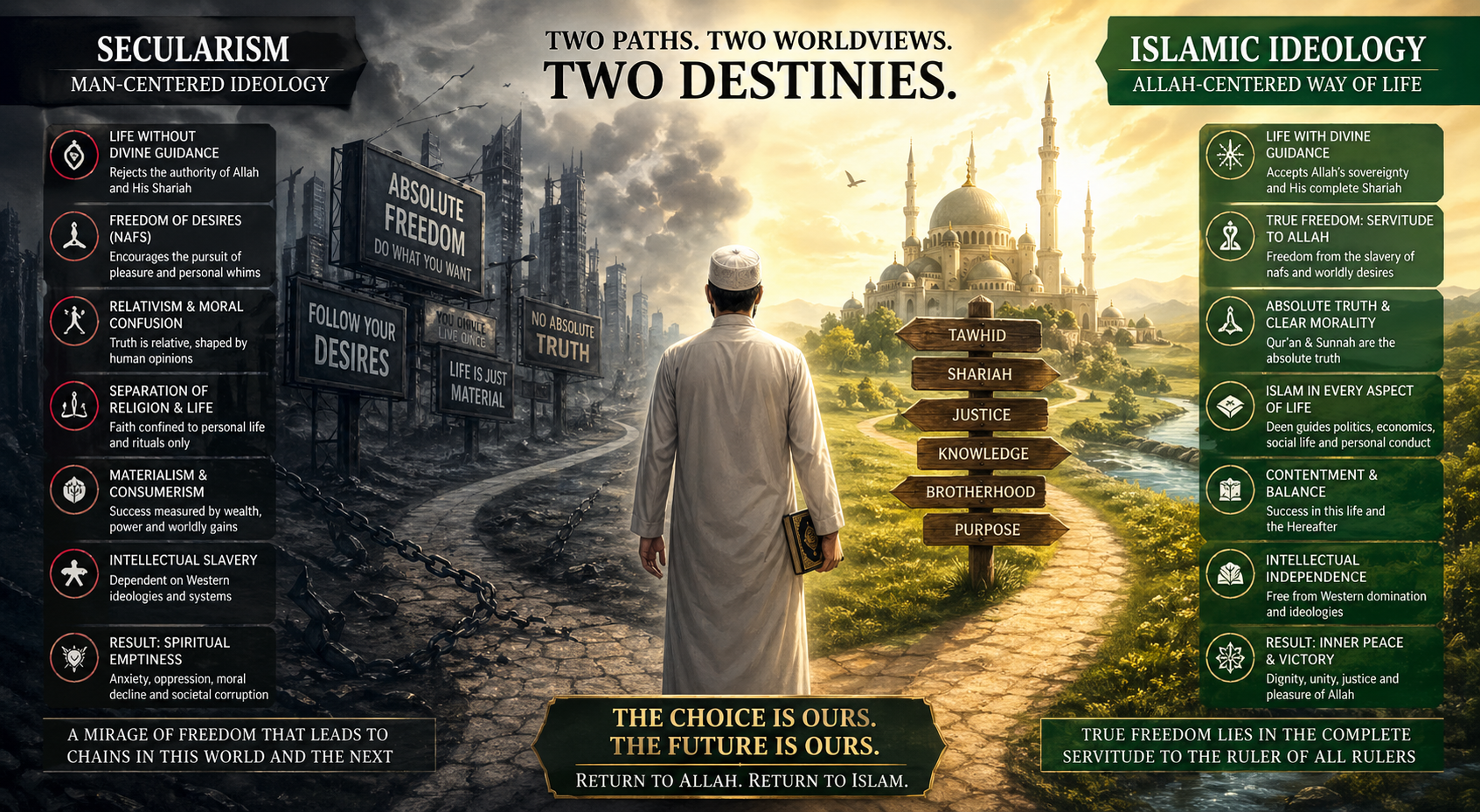
In short, considering all these arguments, it is entirely correct to say that secularism and Islam are the opposite of each other. Islam is not merely the name of a few individual rituals confined to the mosque; rather, it is a complete code of life, including politics, economics, and social affairs. The alluring concept of freedom presented by the West is a mirage of intellectual slavery, which is not permissible for a believer to adopt or surrender to. Today, the Muslim Ummah needs to emerge from its sense of inferiority and the colonial yoke of Western ideologies and return to pure Islamic teachings with full conviction. This is because true freedom does not lie in the blind following of one’s desires (Nafs) but remains hidden in complete servitude to the Ruler of all Rulers and the implementation of His Shariah.

This will close in 20 seconds